Legally protect your brand name and logo. In India, trademark rights go to whoever files first — not whoever used the name first. Don't let a competitor register your brand before you do.
₹5,499 Incl. Govt FeeSame-Day Filing10-Year Protection100+ Companies Served
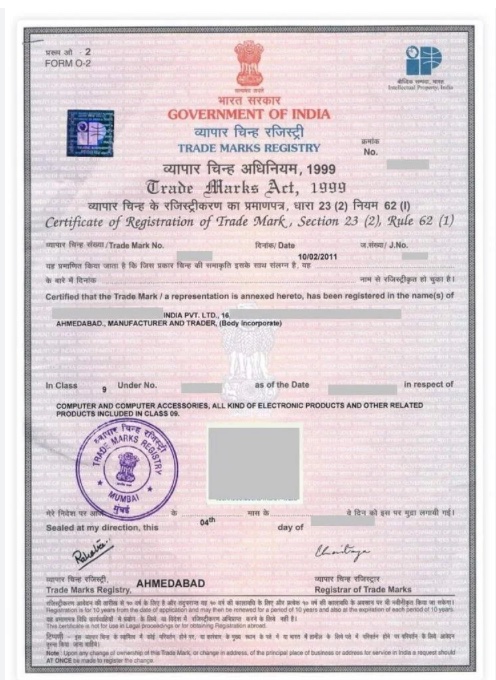
Sample Certificate
This is what your official Trademark Registration Certificate will look like — issued by the Trade Marks Registry, Government of India.
Pay in 2 Parts
₹999
Professional fee now · ₹4,500 govt fee before final submission (Total ₹5,499)
Just fill in your details — we handle the entire filing for you
Use the ™ symbol immediately after filing — you signal protection before final registration is even granted.
10-Year Renewable Protection
Once registered, your mark is protected for 10 years and can be renewed indefinitely every decade after that.
Nationwide Exclusive Rights
Stops anyone else in India from using a confusingly similar name or logo in your registered class of goods/services.
Legal Standing to Sue for Infringement
A registered mark gives you a much stronger legal position to take action against copycats and counterfeiters.
Builds a Licensable Business Asset
A registered trademark is intellectual property you can license, franchise, or sell — unregistered names cannot be.
Stronger Domain & Marketplace Disputes
Helps reclaim social handles, domains, or marketplace listings using your name if someone else grabs them first.
Increases Business Valuation
Investors and acquirers view a registered brand as a real, defensible asset — it factors into company valuation.
Foundation for International Filing
An Indian trademark registration is the base you need before extending protection abroad via the Madrid Protocol.
Documents Needed
What You'll Need to Provide
🏷️Brand name and/or logo you want to register
📄Certificate of Incorporation (or ID proof if registering as an individual)
🎨Logo file — only if you have one to trademark (optional for word marks)
Process
How It Works
1
Fill the Form
Tell us your brand name and what it covers.
2
Pay Our Fee
₹999 via UPI — govt fee due before filing.
3
We File Today
Filed with the Trade Marks Registry same day.
4
Use ™ Immediately
Start using ™ while registration completes.
FAQ
Common Questions
How long does the full trademark registration process take?
Filing happens the same day you submit your application, and you can start using the ™ symbol immediately afterward. However, the complete journey to a registered mark — examination by a Trademark Officer, publication in the Trademark Journal for opposition, and final grant — typically takes 12 to 18 months if there are no objections or oppositions along the way. Some straightforward applications can be granted faster, while marks that face examination objections or third-party oppositions can take longer. We track your application status throughout and keep you updated at each stage.
Do I need a logo, or can I just register my brand name?
You can register just your brand name without any logo — this is called a "word mark" and is often the smarter first move since it protects the name itself regardless of how you style it visually. If you also have a distinctive logo design, you can register that separately as a "device mark," which protects the specific visual design but not the name in other fonts or styles. Many businesses start with a word mark for the name and add a device mark for the logo later once the branding is finalized.
What does "trademark class" mean, and why does picking the right one matter so much?
Trademarks in India are registered under one or more of 45 classes, each covering a category of goods or services (for example, Class 25 covers clothing, Class 42 covers software/IT services). Your protection only applies within the class(es) you register under — a clothing brand registering only in Class 25 has no rights to stop a software company using the same name in Class 42. Choosing the wrong class is one of the most common and costly mistakes in DIY trademark filing, since the government fee is non-refundable even if the class doesn't match your actual business. We determine the correct class based on your description of what products/services your brand covers.
What happens if someone files an opposition against my trademark application?
After your application clears initial examination, it's published in the Trademark Journal for 4 months, during which anyone who believes your mark conflicts with their existing rights can file an opposition. If this happens, we draft and file a formal counter-statement defending your application, and the matter may proceed to a hearing before the Trademark Registry. Oppositions are relatively uncommon for genuinely distinctive marks but more likely if your name is similar to an existing registered brand — this is exactly why a proper trademark search before filing (which we conduct) is valuable.
Why is the payment split into ₹999 first and ₹4,500 later instead of one payment?
The ₹999 is our professional fee, covering the trademark search, class determination, and application preparation — paid upfront. The ₹4,500 government filing fee is collected separately, right before final submission to the Trade Marks Registry, since this amount goes directly to the government and not to us. This structure lets you confirm everything looks correct (brand name, class, applicant details) before the government fee is paid and the application is actually filed.
Can I trademark a name that's similar to an existing brand in a different industry?
Generally yes, since trademark protection is class-specific — "Apple" the fruit brand and "Apple" the electronics company can coexist because they operate in entirely different classes with no likely confusion. However, this gets more nuanced for "well-known marks" (extremely famous brands), which can sometimes claim broader protection across unrelated classes under Indian trademark law. We run a clearance search before filing to flag any genuine conflict risk specific to your proposed name.
What's the difference between ™ and ® symbols, and when can I use each?
You can use the ™ symbol as soon as you've filed your application — it signals that you're claiming trademark rights even before registration is finalized, and is a deterrent against others adopting a similar name. The ® symbol can only legally be used after your trademark is fully registered and granted by the Trade Marks Registry — using ® before actual grant is technically a misrepresentation. We'll notify you the moment your registration is granted so you can switch to ®.
Do I need a Digital Signature Certificate (DSC) for trademark filing?
Yes, a Class-3 DSC is required to digitally sign and file the trademark application with the Trade Marks Registry. If you don't already have one, we help arrange it — typically using your GST Certificate as supporting proof, or a Bank Statement if GST isn't available, or a simple Letterhead Declaration as a last resort (the format for which we'll share via WhatsApp). This is a one-time requirement and the same DSC can be reused for future filings.
Can an individual register a trademark, or does it have to be a registered company?
Individuals, sole proprietors, partnership firms, LLPs, and companies can all apply for trademark registration — there's no requirement to be formally incorporated. If you're applying as an individual, we use your Aadhaar/PAN as identity proof instead of a Certificate of Incorporation. Many freelancers, consultants, and solo brand owners register their personal or business name as a trademark before incorporating a formal entity.
What if I want to expand my trademark protection to other countries later?
Your Indian trademark registration serves as the foundation for international expansion through the Madrid Protocol, an international treaty that lets you file a single application to seek protection across 130+ member countries, rather than filing separately in each country. India is a Madrid Protocol member, so once your domestic registration is in place, extending protection internationally becomes a streamlined process rather than starting from scratch in each jurisdiction — we can guide you through this when you're ready to expand.