Get DPIIT recognition under Startup India — unlock a 3-year income tax holiday, angel tax exemption, and fast-track IP filing benefits. Comes with a free Digital Signature Certificate.
₹3,499 All InclusiveFree DSC Worth ₹1,200100% Online100+ Companies Served
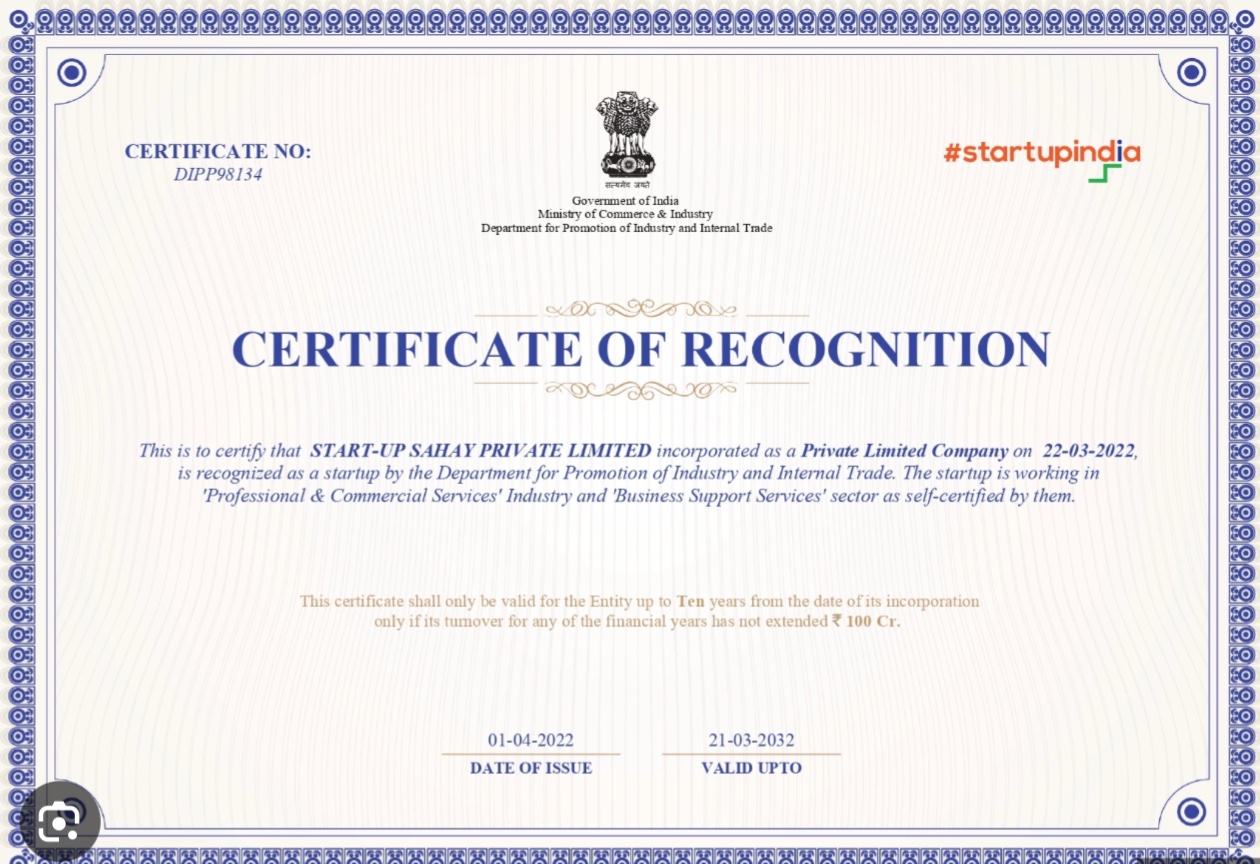
Sample Certificate
This is what your official DPIIT Startup India Certificate of Recognition will look like — issued by the Department for Promotion of Industry and Internal Trade.
Pay in 2 Parts
₹2,500
Advance now · ₹999 pending after you sign the documents (Total ₹3,499)
Just fill in your details — we handle the entire filing for you
Under Section 80-IAC, claim 100% tax exemption on profits for any 3 consecutive years within your first 10 years.
Angel Tax Exemption
Funds raised from angel investors above fair market value are exempt from tax under Section 56, easing fundraising.
80% Patent Fee Rebate
Pay only 20% of standard patent filing fees, plus priority/fast-track examination ahead of regular applications.
Self-Certification Compliance
Self-certify compliance under 6 labour laws and 3 environmental laws for 3-5 years, reducing inspection burden.
Faster Winding Up
Eligible startups can be wound up within 90 days under the Insolvency and Bankruptcy Code's fast-track process.
Government Tender Relaxation
Exemption from prior turnover and experience requirements in select government tenders for DPIIT-recognized startups.
Free Digital Signature Certificate
A Class-3 DSC (worth ₹1,200) is included with our service, needed for several government filings and bank processes.
Startup India Hub Networking
Access to government-curated investor connect events, mentorship programs, and state startup policy benefits.
Documents Needed
What You'll Need to Provide
📄Certificate of Incorporation (COI)
📋MOA — we take director and address details from here directly
🔖Authorized signatory's Aadhaar Card
🪪Authorized signatory's PAN Card
📸Authorized signatory's passport size photo
Process
How It Works
1
Fill the Form
Upload documents, describe your business in 2 lines.
2
Pay Advance
₹2,500 via UPI, rest after signing.
3
We File on NSWS
DSC arranged, application submitted.
4
Get Recognized
DPIIT certificate delivered via WhatsApp.
FAQ
Common Questions
Is my company eligible for Startup India recognition?
Your entity needs to meet four criteria together: it must be registered as a Private Limited Company, LLP, or Registered Partnership Firm (sole proprietorships are not eligible); it must be incorporated for less than 10 years; its annual turnover must not have exceeded ₹100 Crore in any financial year since incorporation; and most importantly, it must be working towards innovation, development, or improvement of products/services, or have a scalable business model with high potential for employment or wealth creation. We assess your business description during the form to help frame this correctly for DPIIT's review.
What exactly counts as an "innovative" or "scalable" business model?
DPIIT doesn't require you to have invented something entirely new — "innovation" is interpreted broadly to include new products, new processes, improved efficiency, or even applying an existing technology to an underserved market in a novel way. "Scalable" means the model can grow significantly without a linear increase in costs — typical of tech platforms, franchise models, or asset-light service businesses. The application asks you to describe your value proposition in your own words, and a well-articulated description focusing on the problem you solve and why your approach is different is the single biggest factor in approval, far more than having a patent or being in a "tech" sector.
Do I need a Digital Signature Certificate (DSC) before I apply?
A Class-3 DSC is required to digitally sign the recognition application on the National Single Window System (NSWS) portal, and we include one free of cost as part of this service (worth ₹1,200 separately). To issue the DSC in your name, the certifying authority needs a supporting document — ideally your GST Certificate. If you don't have GST, a recent bank statement works as an alternative, and if neither is available, we can proceed with a simple declaration on your company letterhead, which we'll share the format for over WhatsApp after you submit the form.
How is the MOA used in this process, and why don't you ask for director details separately?
Your Memorandum of Association already contains your company's registered address and the names of all directors/partners as filed with the Registrar of Companies — re-typing this information manually introduces a real risk of typos that cause mismatches during DPIIT's verification against MCA records. By extracting these details directly from your MOA, we ensure the application matches your official company records exactly, which significantly reduces the chance of the application being sent back for correction.
How long does DPIIT recognition actually take once we apply?
Once your application and DSC are ready, the recognition certificate is typically issued within 2-3 weeks if all details are in order. The biggest factor affecting timeline isn't government processing speed — it's how clearly the innovation/business description is written, since vague or generic descriptions ("we provide quality services to customers") are the most common reason for additional queries or rejection. We help frame your description to clearly articulate the problem, your specific solution, any early validation, and growth potential, which keeps the process moving smoothly.
What's the difference between the old Startup India portal and NSWS?
DPIIT recognition applications now go through the National Single Window System (NSWS) — a unified government portal that consolidates approvals across multiple departments, rather than the standalone Startup India website used previously. Functionally this means your application, DSC verification, and eventual queries from DPIIT all happen on one integrated platform. We handle the entire NSWS submission on your behalf, so this transition doesn't add any extra steps for you.
Can I get a tax exemption immediately after recognition, or is there another step?
DPIIT recognition and the Section 80-IAC tax exemption are two separate approvals. Recognition (what this service covers) makes you eligible to apply for the tax exemption, but the exemption itself requires a second, separate application to the Inter-Ministerial Board (IMB) with additional financial documentation, typically done closer to when you'd actually benefit from the exemption (i.e., once you're profitable). We can guide you on this follow-up application when you're ready for it — there's no urgency to file it immediately upon recognition.
What happens if my application gets a query or is sent back by DPIIT?
If DPIIT raises a clarification query — most commonly asking for more detail on the innovation angle — we draft and submit the response on your behalf at no extra charge, since this falls under our service for this filing. Resubmissions due to genuinely incorrect or fraudulent information provided by the client may attract additional processing charges, but standard clarification queries (which are common and not a sign of a weak application) are handled as part of our existing fee.
Does having a startup award or recognition actually help my application?
Yes, meaningfully. While not mandatory, prior recognition — from a government-recognized incubator, state startup policy, accelerator program, or industry competition — gives the DPIIT reviewer external validation of your business beyond your own description, and this can speed up approval and reduce the likelihood of a clarification query. If you have any such recognition, even informal ones like incubation at a college innovation cell, it's worth mentioning and attaching proof of in the application.
Why does the price have an advance and a pending amount instead of one flat fee?
The ₹2,500 advance covers preparing and submitting your DPIIT application, arranging your free DSC, and handling the back-and-forth until recognition is granted. The remaining ₹999 is collected only after you've digitally signed the final set of documents — this structure means you're not paying the full amount upfront before any real work has been completed, and it aligns our incentive with actually getting your application through successfully.