Register your business as a Micro, Small, or Medium Enterprise on the official Udyam portal. Unlocks collateral-free loans, priority sector credit, and government scheme access — done in 24 hours.
₹399 All Inclusive24 Hour Delivery100% Online100+ Companies Served
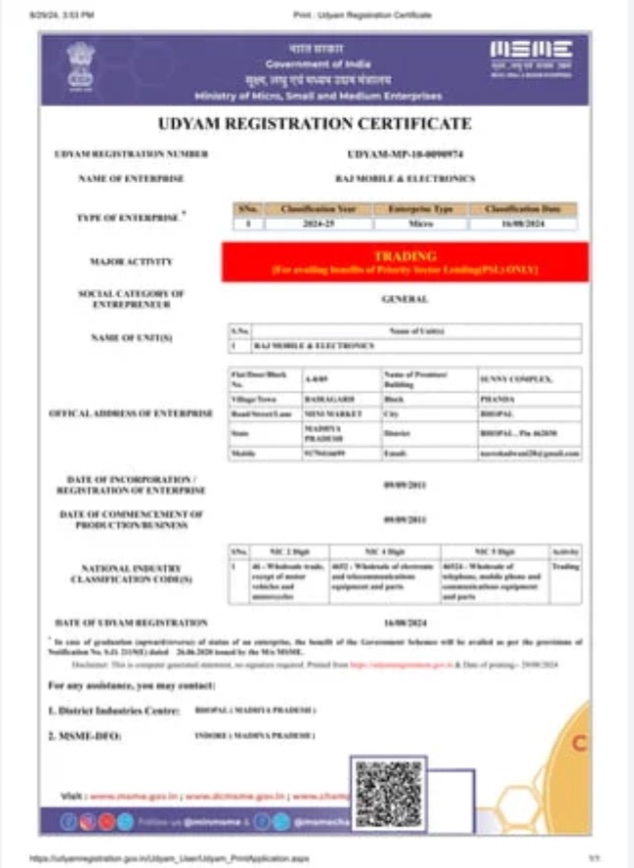
Sample Certificate
This is what your official Udyam Registration Certificate will look like — issued by the Ministry of MSME, Government of India.
All-Inclusive Price
₹399
No hidden charges, no surprise add-ons
Just fill in your details — we handle the entire filing for you
Priority sector lending up to ₹2 Crore without collateral, backed by government credit guarantee schemes.
MUDRA Scheme Access
Eligible for government funding schemes designed specifically for micro and small enterprises.
Tax & Fee Concessions
Reduced court fees for trademark/patent filing, lower interest rates on business loans.
Government Tender Priority
Many government tenders reserve a percentage exclusively for MSME-registered businesses.
Faster Payment Recovery
Buyers must pay MSMEs within 45 days; delayed payments attract compound interest under the MSME Development Act.
ISO Certification Reimbursement
One-time subsidy to cover ISO 9001/14001/45001 certification costs under government MSME schemes.
Electricity Bill Concessions
Many state governments offer reduced electricity tariffs and exemptions for MSME-registered manufacturing units.
Credibility With Lenders & Buyers
An official Udyam number signals legitimacy to banks, NBFCs, and larger companies looking to onboard you as a vendor.
Documents Needed
What You'll Need to Provide
📄Certificate of Incorporation (or business registration proof)
🪪Company PAN Card
🔖Director / Proprietor's Aadhaar Card (mobile-linked, for OTP)
Process
How It Works
1
Fill the Form
Upload documents, answer a few quick questions.
2
Pay Online
₹399 via UPI — instant payment link.
3
We File It
Filed on the Udyam portal same day.
4
Get Certificate
Delivered on WhatsApp within 24 hours.
FAQ
Common Questions
Can I apply right after incorporation?
Yes — in fact, Day 1 after incorporation is the ideal time to register. The Udyam portal is fully digital, paperless, and is built around the Aadhaar number of the proprietor, partner, or authorized director. You don't need to wait for your first invoice, your first sale, or any minimum turnover threshold — even a newly incorporated company with zero revenue can register. Many of our clients register their MSME certificate within the same week they receive their Certificate of Incorporation, specifically so they have access to government schemes from the very start of their business journey.
What's the difference between Micro, Small, and Medium enterprises?
The classification is based on two factors together: your investment in plant & machinery (or equipment, for service businesses) and your annual turnover. A Micro enterprise has investment up to ₹2.5 Crore and turnover up to ₹10 Crore. Small enterprises go up to ₹25 Crore investment and ₹100 Crore turnover. Medium enterprises extend to ₹125 Crore investment and ₹500 Crore turnover. Almost every new company we register starts out as "Micro" since they haven't yet built up significant turnover or asset base — we determine the precise category for you during filing based on the financial details you provide, and there's no extra cost regardless of which tier you fall into.
How long is the Udyam certificate valid, and does it need renewal?
Unlike many other government registrations, the Udyam Registration Certificate has no expiry date and does not need periodic renewal. It remains valid for the lifetime of the business as long as the enterprise continues operating. However, you are required to update your turnover and investment figures on the portal annually (this is linked to your Income Tax Return and GST filings), so that your enterprise classification — Micro, Small, or Medium — stays accurate. We can assist with this annual update as part of our ongoing compliance support if needed.
Do I need a GST number to register for MSME / Udyam?
No, GST registration is not mandatory to obtain an Udyam certificate. The government has specifically exempted businesses that fall under the GST exemption threshold (or those dealing in exempted goods/services) from needing a GSTIN for this registration. If you already have a GST number, we will link it during filing since it strengthens your profile for banks and tenders, but its absence will not block or delay your MSME registration in any way.
Can a sole proprietorship or partnership firm register, or is it only for companies?
MSME / Udyam registration is open to virtually every legal structure — sole proprietorships, Hindu Undivided Families (HUF), partnership firms, LLPs, private limited companies, public limited companies, co-operative societies, and trusts can all apply, as long as they are engaged in manufacturing, production, processing, or service activities. We handle the registration process the same way regardless of your entity type — the only difference is which identity document (Aadhaar of the proprietor versus Aadhaar of an authorized signatory) and which incorporation proof we use.
What happens if I provide incorrect information during registration?
Providing false information on the Udyam portal — such as inflating or understating turnover, or misrepresenting your business activity — can lead to penalties under the MSME Development Act, including fines and potential cancellation of your registration along with any benefits already claimed. This is exactly why we cross-check the figures you provide against your incorporation documents and, where possible, your financial statements before submitting. If your business details change materially after registration (say, a jump in turnover that moves you from Micro to Small), you're expected to update this on the portal, and we can help with that update as well.
Will MSME registration help me get listed on government e-marketplace (GeM) or get preference in tenders?
Yes, significantly so. Government departments and Public Sector Undertakings (PSUs) are mandated to procure a minimum of 25% of their annual purchases from MSME-registered vendors, with sub-quotas reserved specifically for women-owned and SC/ST-owned MSMEs. Many tenders also waive the requirement for "prior turnover" or "prior experience" criteria when the bidder is MSME-registered, and on the GeM portal, MSME sellers often get listing priority and reduced performance security deposit requirements. This is one of the most practically valuable benefits for businesses looking to work with government clients.
I run a service business (consulting, IT, agency) — can I still register as MSME?
Absolutely. The MSME definition was expanded in 2020 to cover both manufacturing and service enterprises under the same unified criteria (investment in equipment and annual turnover, rather than the old separate thresholds). IT services, consulting firms, marketing agencies, e-commerce sellers, freelance studios, and most other service-based businesses are all eligible and commonly register. We select the appropriate NIC (National Industrial Classification) activity code that matches your specific service during the filing process.
What documents do I actually need to keep ready, and why?
You'll need three things: your Certificate of Incorporation (or business registration proof for proprietorships/partnerships), which tells us your legal entity name, registration number, and incorporation date; your company PAN card, which is used to validate financial details against Income Tax records; and the Aadhaar card of the proprietor, managing partner, or authorized director, since Udyam registration is Aadhaar-authenticated and an OTP will be sent to the Aadhaar-linked mobile number during the actual filing step. We don't ask for anything beyond these three because the portal itself doesn't require more for a standard registration.
Can I upgrade or change my registration later if my business grows?
Yes — your Udyam classification (Micro, Small, or Medium) is not fixed for life. As your turnover and investment grow, your enterprise can graduate from Micro to Small, or Small to Medium, and the system automatically reflects this once you update your figures (typically pulled from your ITR/GST data). There's a built-in "non-regression" benefit too — even if your business graduates to a higher category, you continue to receive the benefits of your previous, lower category for one additional year, giving you a buffer period before fully transitioning to the new tier's terms.