Get your GSTIN — the 15-digit GST Identification Number mandatory for businesses above ₹20 Lakh turnover. Required for issuing tax invoices, selling on e-commerce, and onboarding B2B clients.
₹1,999 All Inclusive3–7 Working Days100% Online100+ Companies Served
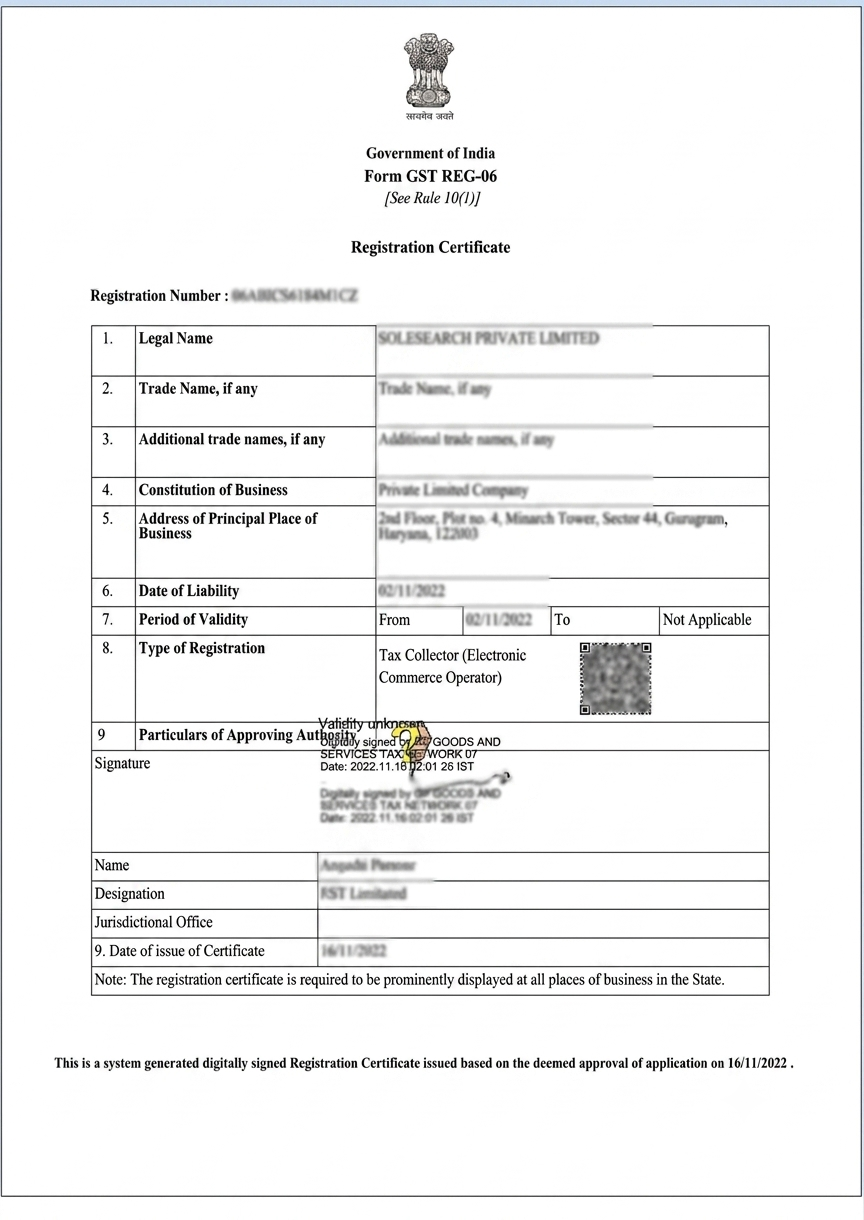
Sample Certificate
This is what your official GST Registration Certificate will look like — issued by the GST Council / GSTN portal, Government of India.
Pay in 2 Parts
₹1,499
Advance now · ₹500 on completion (Total ₹1,999)
Just fill in your details — we handle the entire filing for you
Only GST-registered businesses can issue valid tax invoices — mandatory for B2B clients claiming input tax credit.
Sell on E-Commerce Platforms
Amazon, Flipkart, Meesho — all major e-commerce platforms require a valid GSTIN before listing your products.
Input Tax Credit (ITC)
Claim credit on GST paid on purchases and reduce your overall tax liability — only registered businesses can do this.
Interstate Business Without Limits
Sell goods and services across state borders freely — GST replaced all state-level entry taxes and octroi.
Government Tender Eligibility
Most government tenders and procurement contracts require a valid GSTIN as a basic qualification criterion.
Business Bank Account & Loans
Banks increasingly require GSTIN for current account opening and business loan applications as proof of formal operations.
Avoid Penalties up to ₹25,000
Operating above the threshold without GST registration is an offence with penalties of 10% of tax due or ₹25,000 minimum.
Builds Formal Business Identity
A GSTIN signals compliance and credibility to vendors, clients, and investors — it is increasingly the first thing B2B buyers check.
Documents Needed
What You'll Need to Provide
🪪PAN Card — of the company/LLP or proprietor/individual
🔖Aadhaar Card — of the authorized signatory (mobile-linked for OTP)
📄Certificate of Incorporation / MOA-AOA (for companies and LLPs)
🏠Business Address Proof — electricity bill, rent agreement, or NOC from owner
🏦Bank Account Proof — cancelled cheque or bank statement
Process
How It Works
1
Fill the Form
Upload documents, answer a few questions.
2
Pay Advance
₹1,499 via UPI, ₹500 on completion.
3
We File on GST Portal
Application submitted with OTP verification.
4
Get GSTIN
Certificate on WhatsApp in 3–7 working days.
FAQ
Common Questions
Who actually needs GST registration — is it mandatory for my business?
GST registration is mandatory if your aggregate annual turnover exceeds ₹20 Lakh (₹10 Lakh for businesses in special category states like Uttarakhand, Manipur, etc.). However, even below this threshold, registration is compulsory if you sell interstate, supply goods through an e-commerce platform, or make taxable supplies of any kind. Many businesses also register voluntarily below the threshold to issue proper tax invoices and claim input tax credit — particularly when their B2B clients require it for their own ITC claims.
How long does GST registration actually take, and what is the ARN?
Once your application is submitted on the GST portal with all documents, an ARN (Application Reference Number) is generated immediately — this confirms your application is under review. If all documents are in order and no clarification is raised by the GST officer, registration is typically granted within 3 to 7 working days. If the officer raises a query or asks for additional documents, it can take up to 30 days from the date of the query response. We handle any such queries on your behalf as part of this service.
Do I need a physical office or shop address for GST registration?
You need a valid business address, but it doesn't have to be a commercial space — your home address works as the principal place of business for most service-based and online businesses. If you're operating from home, a recent electricity bill in your name plus an Aadhaar-verified NOC (no-objection certificate) from the property owner suffices. For rented premises, a rent agreement and the landlord's electricity bill are typically required. Virtual offices are also accepted for GST in most states, provided you have a proper agreement with the virtual office provider.
What is the difference between regular GST registration and composition scheme?
Regular GST registration means you collect GST from customers, file monthly/quarterly returns, and can claim full input tax credit on your purchases. The Composition Scheme is a simplified option for businesses with turnover below ₹1.5 Crore (₹75 Lakh for some states) — you pay a fixed percentage of turnover as tax, file quarterly returns, and have much less compliance burden, but cannot claim ITC and cannot supply interstate or through e-commerce. Most service-based businesses and anyone selling online should opt for regular registration. We advise on the right choice based on your business type during the process.
Why is an Aadhaar with a linked mobile number required?
The GST portal uses Aadhaar-based OTP authentication to verify the identity of the authorized signatory during the application process — an OTP is sent to the mobile number linked with the Aadhaar. This cannot be bypassed digitally. If your Aadhaar is not linked to any mobile number, the process requires an in-person biometric verification at a GST Seva Kendra, which adds time and inconvenience. We strongly recommend ensuring your Aadhaar is mobile-linked before applying, and can guide you on how to link it if needed.
Can I register for GST before my business officially starts operations?
Yes — GST registration can be obtained before you start making supplies, and it's often a smart move. Having your GSTIN ready means you can issue tax invoices from day one, onboard B2B clients without delay, and list on e-commerce platforms immediately. Many newly incorporated companies apply for GST registration alongside their company registration, so both are ready when the business begins operating.
What happens after registration — what are my ongoing compliance obligations?
Once registered, you must file GST returns regularly — typically GSTR-1 (monthly or quarterly, outward supplies) and GSTR-3B (monthly summary return with tax payment). The frequency depends on your turnover. Even months with no business activity require a nil return. Non-filing attracts late fees of ₹20–50 per day per return, plus interest on outstanding tax. We offer GST return filing as a separate ongoing service if you need help managing compliance after registration.
Do I need separate GST registration for each state I operate in?
Yes — GST registration is state-specific. If you have a business presence (office, warehouse, branch) in multiple states, you need a separate GSTIN for each state. However, if you only sell interstate from a single location without having any physical presence in other states, one registration in your home state is sufficient. This service covers registration for one state — if you need multi-state registration, message Sourav directly on WhatsApp to discuss the right approach for your setup.
Why is the payment split into ₹1,499 advance and ₹500 on completion?
The ₹1,499 advance covers preparing and submitting your GST application, handling OTP verification, and managing any officer queries until your ARN is generated. The remaining ₹500 is collected only once your GSTIN is actually granted and the certificate is ready — this way, you only pay the final amount after seeing a concrete result, which aligns our interest with successfully completing your registration rather than just submitting the paperwork.
Can my GST registration be cancelled or suspended, and how do I avoid that?
Yes — GST registration can be suspended or cancelled by the officer if returns are not filed for 6 consecutive months (or 3 consecutive quarters for composition taxpayers), if the business is found non-existent at the registered address, or if registration was obtained fraudulently. A suspended registration means you cannot issue tax invoices or collect GST. The simplest way to avoid this is consistent, timely return filing — even nil returns. If your registration is suspended or cancelled, revival requires a formal revocation application and can be complex; it's far easier to stay compliant than to fix problems after they arise.