Food Safety and Standards Authority registration is mandatory for every food business in India — restaurants, manufacturers, cloud kitchens, traders. Operating without it can attract penalties up to ₹5 lakh.
₹999 Basic RegistrationMandatory by LawFoSCoS Portal Filing100+ Companies Served
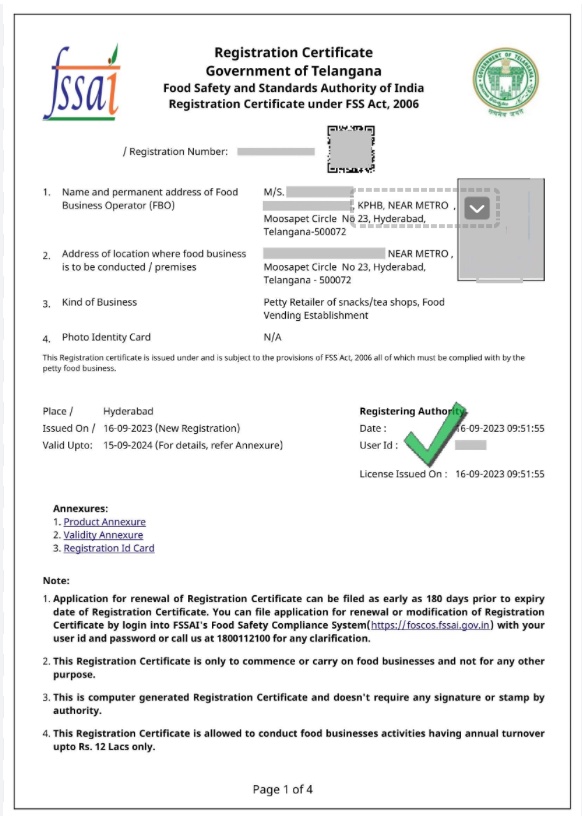
Sample Certificate
This is what your official FSSAI Registration Certificate will look like — issued by the Food Safety and Standards Authority of India.
All-Inclusive Price
₹999
No hidden charges, no surprise add-ons
Just fill in your details — we handle the entire filing for you
Operating a food business without valid FSSAI registration is a punishable offence under the Food Safety and Standards Act.
Mandatory for Delivery Platforms
Swiggy, Zomato, and other food delivery apps require a valid FSSAI license number before listing your business.
Builds Direct Customer Trust
Displaying your FSSAI number on packaging or premises signals safety compliance, especially valuable for new brands.
Required for Export & Wholesale
Most B2B buyers, retail chains, and export channels will not onboard a food supplier without FSSAI registration.
Foundation for Higher Licenses
As your business scales past ₹1.5 Cr turnover, your Basic Registration is the natural starting point before upgrading to a State or Central License.
Covers All Food Business Types
Restaurants, cloud kitchens, manufacturers, traders, and home-based food businesses are all eligible under this registration.
Required for FSSAI-Compliant Labelling
Legally print nutritional information and ingredient lists on your packaging only once registered.
Helps Secure Business Loans
Banks and NBFCs often request FSSAI registration as part of due diligence when lending to food sector businesses.
Documents Needed
What You'll Need to Provide
🪪Identity Proof — Aadhaar Card or PAN Card of the proprietor/director
🏠Business Address Proof — electricity bill, rent agreement, or Certificate of Incorporation
📸Passport size photo of the proprietor/director
Process
How It Works
1
Check Turnover
Confirm you need Basic Registration (under ₹1.5 Cr).
2
Pay Online
₹999 via UPI — instant payment link.
3
We File It
Filed on the FoSCoS portal same day.
4
Get Certificate
Delivered on WhatsApp within a few days.
FAQ
Common Questions
Which type of FSSAI registration do I actually need — Basic, State, or Central?
This is determined entirely by your annual turnover. If your turnover is under ₹1.5 Crore, Basic Registration applies — this is exactly what this ₹999 service covers, and the vast majority of small restaurants, home kitchens, and new food businesses fall into this tier. If your turnover is between ₹1.5 Crore and ₹50 Crore, you need a State License, and above ₹50 Crore you need a Central License — both of these involve additional documentation specific to your business type and operations, so for those tiers we recommend messaging Sourav directly on WhatsApp rather than using this self-service form.
How long is the FSSAI Basic Registration valid, and what happens at expiry?
Basic Registration is granted for a period you choose at the time of application — typically 1 to 5 years — and the registration certificate clearly states the validity period and expiry date. You're required to apply for renewal at least 30 days before expiry; operating with an expired registration carries the same penalties as having no registration at all. We can remind you and assist with the renewal when the time comes if you'd like ongoing support.
Can I apply for FSSAI registration before I actually start operating my food business?
Yes, and it's often a smart move — many businesses register before launch specifically so they're fully compliant from day one of operations, rather than scrambling to register after a customer complaint or inspection. The registration is tied to your business address and identity proof, not to proof of an already-operating business, so there's no requirement to show existing sales or customers before applying.
I run a home-based food business (tiffin service, baking, pickles) — do I still need FSSAI registration?
Yes — FSSAI registration applies regardless of whether you operate from a commercial kitchen, a cloud kitchen, or your home kitchen. The law defines "food business operator" broadly to include anyone manufacturing, processing, packaging, storing, distributing, or selling food, whether for profit or otherwise. Home-based businesses selling on platforms like Instagram, WhatsApp groups, or local delivery apps are increasingly being asked for their FSSAI number, and most legitimate delivery and payment platforms now require it for onboarding.
What exactly counts as my "business address proof" if I'm renting my premises?
If you're renting your premises, a copy of your rent agreement along with a recent electricity bill (which can be in the landlord's name) is generally accepted as address proof. If you own the premises, the electricity bill or property tax receipt in your name works. For very early-stage businesses still finalizing a location, the Certificate of Incorporation showing your registered office address can sometimes be used as an interim option — we'll guide you on the best option based on your specific situation when you fill the form.
Does FSSAI registration involve any kitchen or premises inspection before approval?
For Basic Registration specifically, a physical inspection before approval is uncommon — the process is largely document-based through the FoSCoS portal. However, FSSAI does retain the right to conduct surprise inspections after registration to verify ongoing food safety compliance, and State/Central License categories (for larger businesses) involve more rigorous premises inspection as part of the approval process itself.
What happens if my turnover grows past ₹1.5 Crore after I already have Basic Registration?
You're required to upgrade from Basic Registration to a State License once your turnover crosses the ₹1.5 Crore threshold — this isn't automatic, you need to proactively apply for the upgrade. Continuing to operate on a Basic Registration after exceeding the turnover limit is non-compliant. When you reach this stage, message Sourav directly and he'll guide you through the State License application, which does require some additional documentation compared to Basic Registration.
Can I sell on Swiggy, Zomato, or Amazon without FSSAI registration?
No — virtually all major food delivery and e-commerce platforms in India now mandate a valid FSSAI registration number as part of their seller/restaurant onboarding process, and will not list your business without it. This is one of the most common practical reasons businesses approach us for FSSAI registration — they're ready to launch on a delivery platform and discover this requirement at the onboarding stage.
Do I need separate FSSAI registrations for multiple outlets or locations?
Generally, yes — each physical premises where food is manufactured, processed, stored, or sold typically needs its own FSSAI registration/license tied to that specific address, even if they're all under the same business entity. If you're planning to open multiple outlets, it's worth discussing your expansion plans with us so we can advise on the most efficient registration structure for your specific situation.
Is the FSSAI logo/number required on my food packaging, and what's the exact format?
Yes — once registered, you're required to display your 14-digit FSSAI license/registration number on your product packaging, along with the official FSSAI logo, in the format specified under the Food Safety and Standards (Packaging and Labelling) Regulations. We'll share the exact display requirements along with your certificate so your packaging stays compliant from launch.